
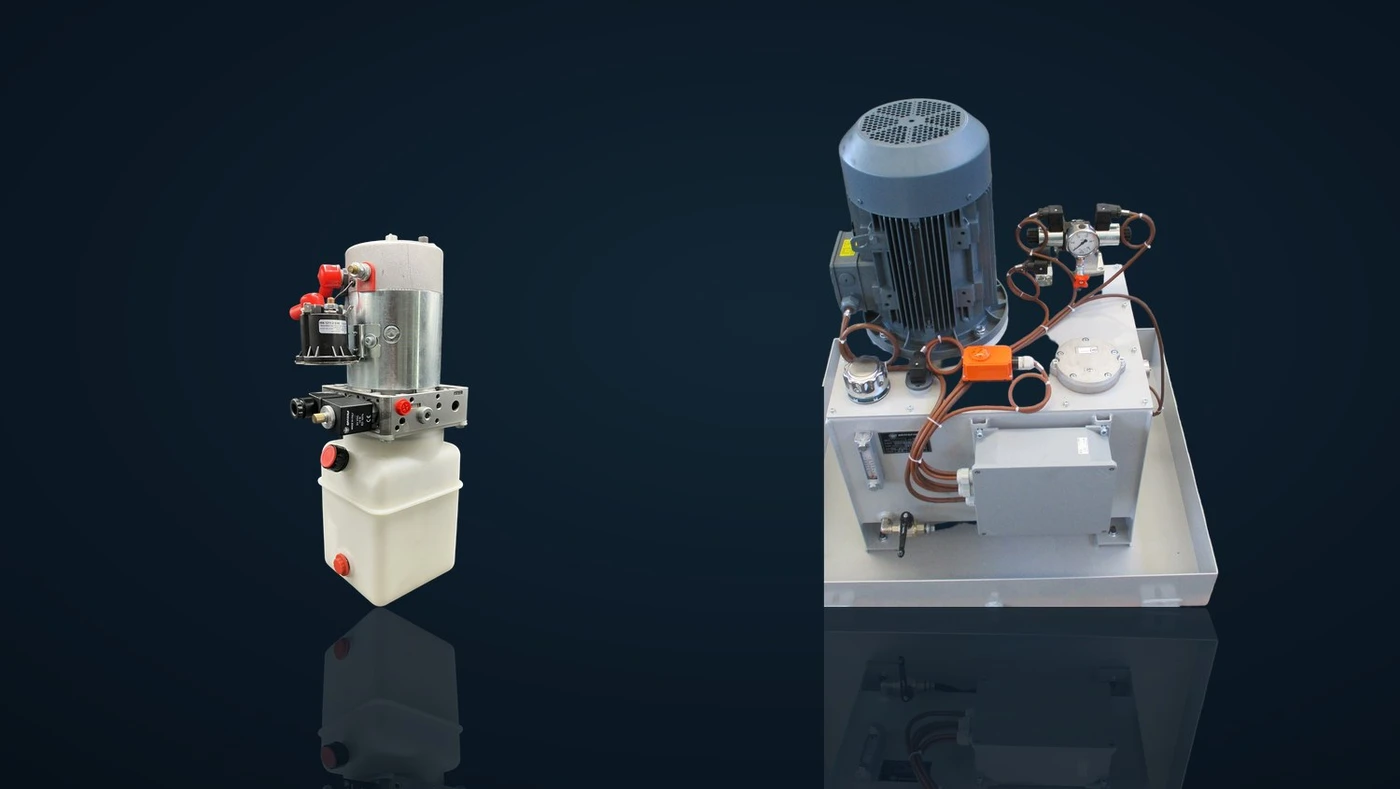
What changes in architecture
A compact power pack is a monoblock: motor, pump, manifold and reservoir in one compact assembly, with valve logic mounted on the manifold. A power unit is a complete system: frame, larger reservoir with level and temperature control, heat exchanger where needed, multiple independent circuits, electrical cabinet. The first integrates into the machine; the second often IS part of the machine.
| Aspect | Compact power pack | Hydraulic power unit |
|---|---|---|
| Indicative power and flow | up to about 5.5 kW and 20 l/min | beyond this threshold |
| Architecture | monoblock: motor, pump, manifold and reservoir in one assembly | frame-mounted system with electrical cabinet |
| Circuits | valve logic on the manifold | several independent, simultaneous circuits |
| Duty and heat | typically intermittent cycles | heavy continuous duty, level and temperature control, heat exchanger |
| Cost for the same function | significantly lower | higher |
When do you need a full power unit instead of a compact pack?
Several simultaneous movements with different flows; continuous duty with oil heating up; demanding filtration and monitoring requirements; power beyond what compact motor frame sizes can deliver. If you recognise at least two, start directly from a power unit design: stretching a compact pack beyond its limits costs more than designing it right from the start.
And the cost?
For the same function, the compact pack costs significantly less: less material, less assembly, a shorter BOM. That is why honest sizing serves both sides: proposing a power unit where a compact pack would do is exposed by the first competing quote. Our price-factors guide explains in detail what drives cost.